








Dr. Hugh Cutcher
April 29, 2026
Share this post
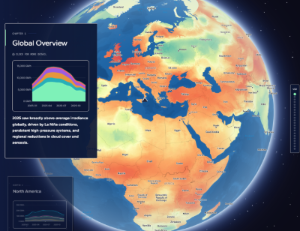
The June, July and August 2026 seasonal outlook points to broadly neutral to positive solar irradiance conditions across many key solar regions, with several coherent regional signals consistent with a developing El Niño. The strongest positive anomalies are concentrated across the Maritime Continent and Australasia, parts of South Asia later in the season, the Sahel and parts of West Africa, and Central America by August. Europe trends neutral to modestly positive overall. Negative anomalies are concentrated mainly in early-season monsoon regions, but in several cases weaken or reverse as the season progresses.
%20(3).png)
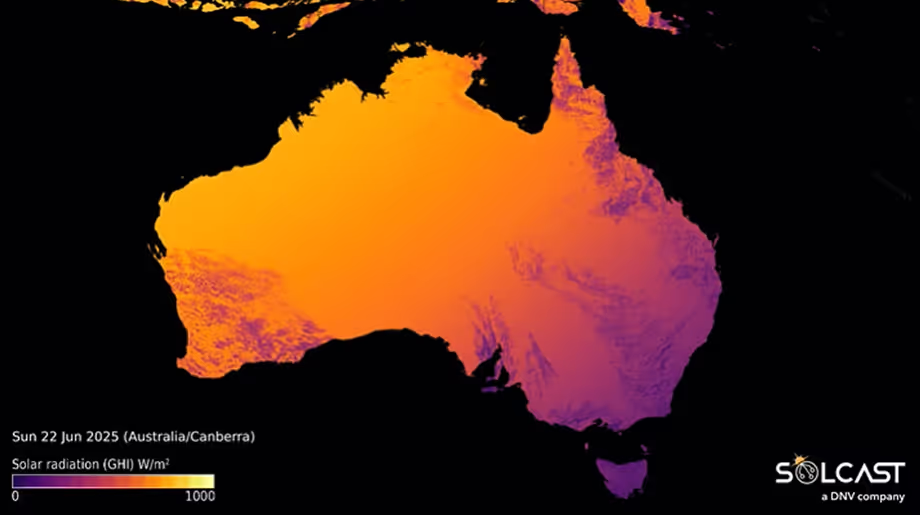
Across the Maritime Continent and Australasia, the outlook shows a clear progression towards higher-than-average irradiance through the three-month period. Conditions in June are already slightly positive compared to the long-term average, but positive anomalies strengthen in July and become more pronounced in August, with parts of Malaysia, Indonesia, northern Australia and the Coral Sea approaching 20% above average. This pattern is consistent with reduced cloudiness across the region, a familiar early signal of developing El Niño conditions. For solar assets, it points to a generally favourable winter period in Australia and surrounding markets, even though the signal remains relatively mild at the start of the season.
.png)
In South Asia, the seasonal anomaly signal evolves more sharply. June is forecast to be cloudier across India, as the summer monsoon typically brings around this time, leaving irradiance near normal or slightly below average. By July and August, however, that pattern reverses, with clearer conditions emerging over large parts of India and Pakistan. August shows the strongest positive anomalies, in some areas approaching 20% above the long- term average. A similar suppression of cloud cover is evident across the Sahel and parts of West Africa, where above-average irradiance persists through much of the season. In both regions, the pattern has been linked to weaker monsoon activity, that can occur during the El Niño development.
.png)
Europe presents a quieter but still constructive signal. June shows mild positive anomalies over the Iberian Peninsula and parts of eastern Europe, while southern Europe and the UK remain close to average. In July and August, positive anomalies broaden across much of the continent, extending from France through central and eastern Europe, with most areas forecast to sit around 5% to 10% above average. There are still pockets of neutrality and slight weakness, particularly around the UK and parts of southern Europe early in the period, but no large, persistent negative signal dominates the European outlook.
.png)
In the Americas, Central America stands out for its late-season shift. June begins with below-average irradiance, but conditions are forecast to improve quickly, turning positive in July and strengthening further by August, when anomalies approach 20% above average. This is again broadly consistent with an El Niño backdrop. The United States shows a weaker and more mixed signal. The south-east trends slightly positive, while the south- west may see a slight uplift later in the season. By contrast, the Pacific North-West leans slightly negative, suggesting more persistent cloud cover and little sign of a strong seasonal signal for utility-scale solar in the country’s main south-western markets.
.png)
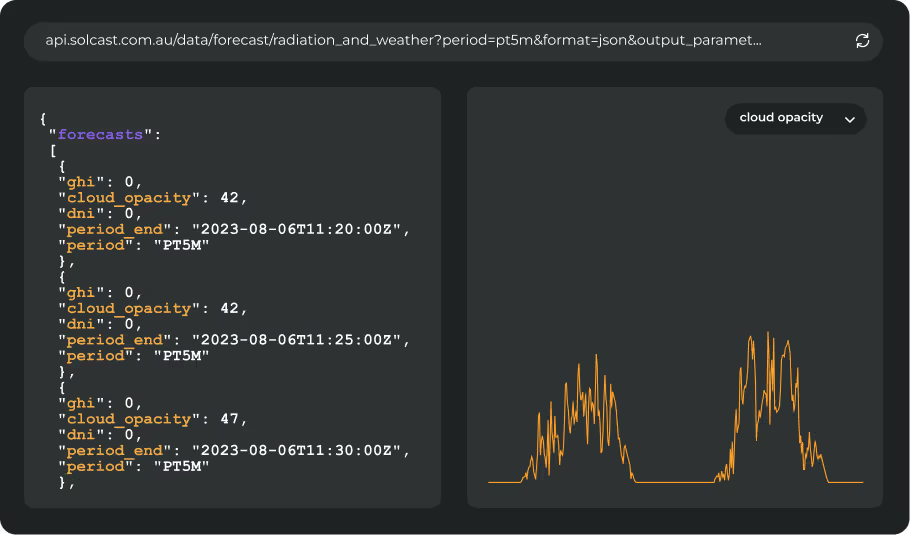
Track weather conditions, cloud movements, and irradiance-influencing factors that might impact your solar generation. Access bankable actuals and accurate forecasts when you sign up for a Solcast API toolkit. You can reach out to our team for an extended trial.